The history of Haiti
From the Taíno of Ayiti to the only successful revolution of enslaved people in human history — the making of the first Black republic.
Five centuries, one people
The original peoples
Long before Europeans, the Taíno called the island Ayiti — land of high mountains. Their legacy survives in the nation's very name.
Saint-Domingue
Under French rule, the western third of the island became the world's most profitable colony, its wealth extracted through the brutal enslavement of Africans brought by force across the Atlantic.
The Revolution (1791–1804)
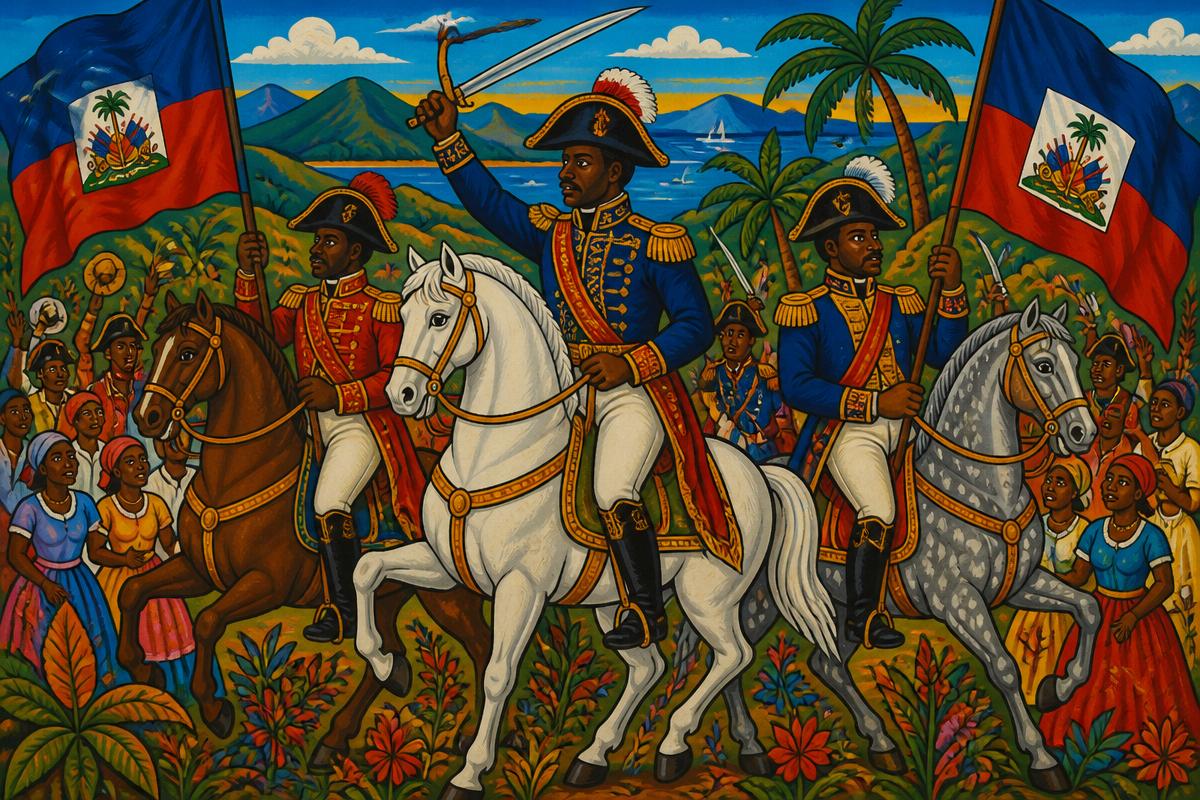
Enslaved Africans, free people of color, and visionary leaders waged a thirteen-year war that defeated the armies of France, Spain, and Britain — and abolished slavery for good.
Independence and its cost
Haiti became the first country founded by formerly enslaved people — and paid a crushing indemnity to France that shaped its economic trajectory for over a century.
Key moments in Haitian history
- ~500 BCE
The Taíno
Indigenous Taíno (Arawak) people settle the island of Ayiti/Quisqueya, farming cassava and building organized communities.
- 1492
Columbus arrives
Christopher Columbus lands on the northern coast, renaming the island Hispaniola. Spanish colonization begins, decimating the Taíno population.
- 1697
French colony
The Treaty of Ryswick formally cedes the western third of the island to France, becoming Saint-Domingue — the wealthiest colony in the Caribbean, built on enslaved labor.
- 1791
The uprising begins
Enslaved people launch the Bois Caïman ceremony and a massive revolt. The Haitian Revolution — the only successful enslaved-people revolution in history — begins.
- 1794
Abolition in the colony
France abolishes slavery in all its territories. Toussaint Louverture rises to lead the former enslaved forces, mastering politics between France, Spain, and Britain.
- 1802
Louverture captured
Napoleon sends forces to re-enslave the colony. Toussaint Louverture is betrayed, arrested, and deported to France, where he dies in 1803.
- Nov 18, 1803
Battle of Vertières
Jean-Jacques Dessalines defeats the French army at Vertières, the decisive final battle of the revolution.
- Jan 1, 1804
Independence
Dessalines declares independence at Gonaïves, renaming the nation Haiti after the original Taíno name for the island. The first Black republic is born.
- 1806
A divided nation
After Dessalines's assassination, Haiti splits into a northern kingdom under Henri Christophe and a southern republic under Alexandre Pétion.
- 1825
The debt
France demands 150 million francs in indemnity for recognizing Haitian independence — a crippling debt paid over more than a century.
- 1862
U.S. recognition
The United States formally recognizes Haiti, nearly six decades after independence.
- 19th–21st c.
Modern Haiti
Haiti endures occupation, dictatorship, natural disasters, and political upheaval while sustaining one of the most vibrant cultural traditions in the Americas.
Meet the people who led the revolution
From Toussaint Louverture to Catherine Flon, Haiti's story is carried by its people.
Explore the figures