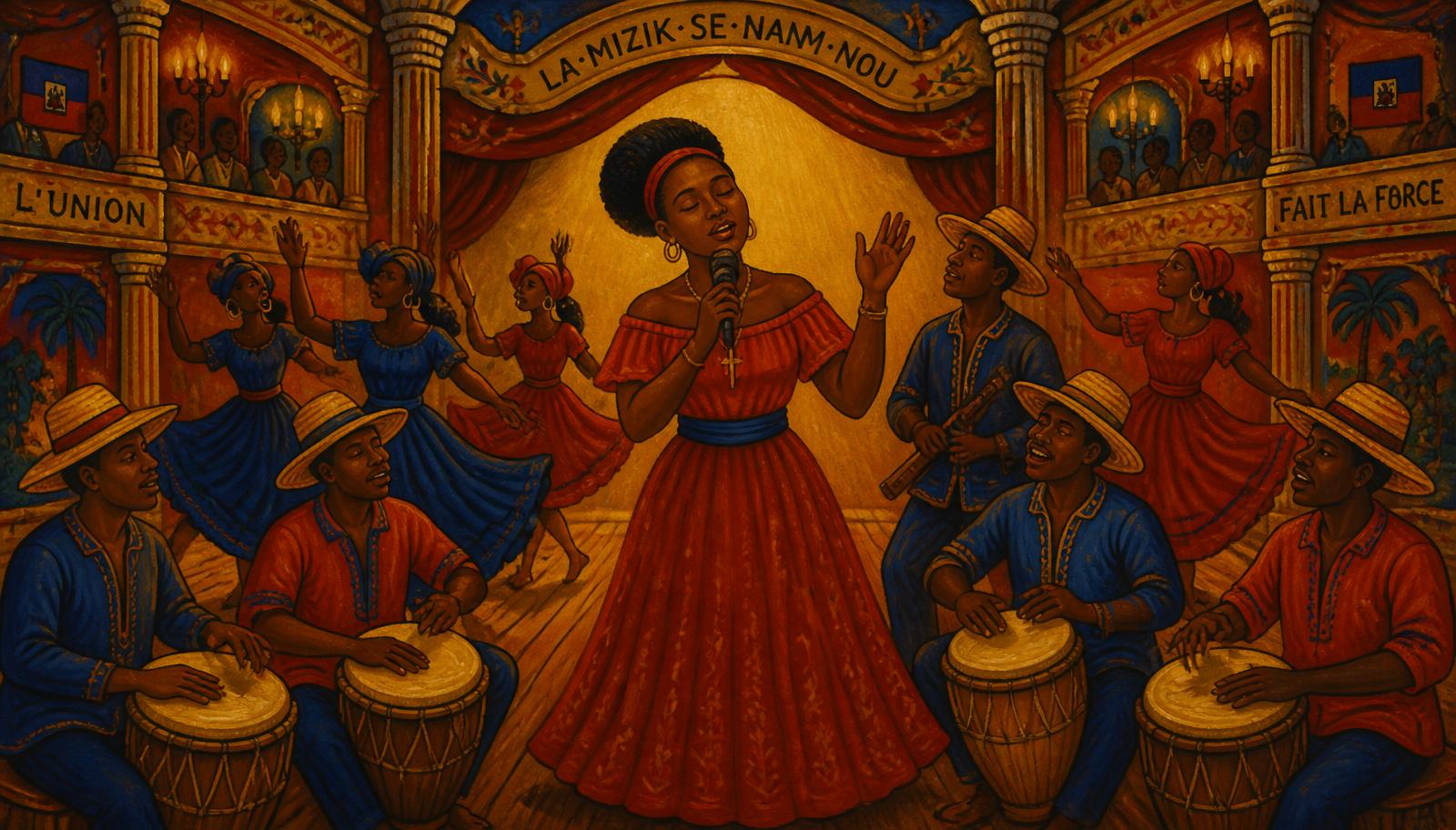
Haitian naïve-art painting of a singer, tanbou drummers and dancers on a golden-lit stage

Documentary Prompt

Ayiti Bèl Nanm

“Haiti, Beautiful Soul” — a love letter to a story waiting to be told

August 15, 2026 Adrienne Arsht Center, Miami

Read this first

You are about to be invited into something sacred: a moment when a Haitian woman honors her son's memory by telling her nation's story on her own terms.

This is not a film about crisis, rescue, tragedy or pity. This is a film about love — how artists love their ancestors, how mothers love their children, how diaspora families love a homeland they carry in their hearts, how a community loves itself back into visibility.

If you make this film, you are making an act of resistance disguised as beauty.

The story at the center

Imagine losing your son. Now imagine channeling that grief into a vision so big, so necessary, that it becomes a moment of cultural healing for thousands. That's Carole Demesmin.

Born in Léogâne, trained at Berklee, she spent decades making music that whispered to diaspora families: your culture is not something to hide, it is gold. Her son Louis-Philippe, living in Belgium, wanted his friends to understand that Haiti is not poor — Haiti is rich, creative, alive. He died before he could show them. So Carole did.

On August 15, 2026, at one of the most prestigious theaters in the United States, a Haitian woman and her ensemble will fill the stage with tanbou drums, Kreyòl poetry, and bodies moving in rhythms older than the nation itself.

Your job is not to capture the performance. Your job is to capture why this moment matters so much that it moves people to tears.

Three movements

A film about cultural sovereignty, told in three parts.

I

The Seeds

When everything begins with loss and love

Open in Carole's voice. Kreyòl. Speaking about her son. Not explaining. Not performing. Just remembering.

“Louis-Philippe lived in Brussels. He wanted his friends to understand Haiti. Not the Haiti of the news. The Haiti of the music. The Haiti of the soul.”

As she speaks: a photograph of a young man, smiling. Léogâne at morning light. A woman braiding another woman's hair. Brussels, gray streets, a man writing something down. The faces of drummers, dancers and poets about to become an ensemble.

Let us meet the tanbou not as an instrument but as an ancestor. Show Vodou altars — not as exotic, as home. Show diaspora kitchens in Miami where Kreyòl is spoken and children half-understand, half-absorb.

Visual tone
Warm. Golden. Like memory itself. Archive stills mixed with contemporary footage. No rush — let each image breathe.
What you're capturing
The roots. The inheritance. The weight of what is about to happen.
II

The Work

When vision becomes sweat, doubt, and devotion

Now we live in the rehearsal space. Don't cut away. Stay. Watch Carole direct — not as a boss, as a priestess, as someone who knows every movement carries ancestors.

Watch a choreographer teach a diaspora dancer a step rooted in Haitian tradition, and catch the moment her body gets it — when it stops being choreography and becomes remembering.

Watch a poet rehearse in Kreyòl. Watch her hands, her eyes, and the other artists listening like it's scripture. Let interviews be conversations: Why did you join this? What does Haiti mean to you? Are you nervous?

Watch the doubt too. The argument about artistic choices. The night someone cries because they're overwhelmed. The morning Carole sits alone with her coffee and thinks about her son.

Visual tone
Intimate. Handheld. Following movement like you're dancing too. Close-ups of hands and concentration. Long unbroken takes.
What you're capturing
The alchemy. The sacrifice. The way artists pour themselves into something hoping it will matter.
III

The Reckoning

When a moment becomes a memory becomes a movement

August 15. The night. Show the performance — but never separate the performance from its witnessing.

Cut between the stage (bodies moving in light, drums speaking), the audience (a hand covering a mouth, a child's wonder, an elder's recognition), the wings where Carole watches, and one family of three generations seeing their heritage reflected back at them.

After the curtain falls is where the real documentary lives. A diaspora-born young man: “I came here thinking I was too American for Haiti and too Haitian for America. Tonight I realized I'm both. And that's enough.” An elder: “We kept this alive. With our hands. With our voices. With our refusal. And now — look.”

Carole, alone on the empty stage. Not triumphant. Quiet. Like she has just set something heavy down. The film ends not with resolution but with opening.

Visual tone
Full performance footage, emotionally intercut. The stage and the hearts. You are not making a concert film — you are making a film about transformation.
What you're capturing
The witness. The proof. The beginning of what comes next.

The themes that should pulse underneath

Cultural Sovereignty

What it looks like when people tell their own story, on their own terms, for their own people. Not for approval. Not for pity. For truth.

Diaspora as Sacred Keeper

The people who carry culture across oceans and generations. Who teach their children songs in a language they are forgetting. They are not nostalgic — they are the bridge.

Tradition as Living Thing

Not museum pieces. Tanbou drums played with contemporary choreography. Vodou spirituality in a 21st-century theater. Ancestors in the present moment.

Artistic Leadership

Artists as the ones who show us who we are. As resisters. As healers. As the ones brave enough to say: this matters, you matter.

Generational Transmission

A grandmother seeing herself in her granddaughter's face. A young woman learning a dance and feeling 400 years of people who danced it before her.

Memory as Resistance

Every time a diaspora family remembers Haiti, they resist erasure. Every time they teach their children Kreyòl, they resist assimilation.

Your main characters

Carole Demesmin

The mother, the musician, the director

She is not a hero. She is a woman who decided grief could become creation. Follow her in the quiet moments — making tea, looking out a window. Shoot her close: her hands tell stories, her eyes remember. Let her Kreyòl voiceover be the spine of the film; let subtitles carry the translation.

The Ensemble

The collective heart

Not individual stars. Drummers, dancers, singers and poets from Haiti and the diaspora, shown as one body — how they watch each other, support each other, believe in each other. Capture the moment each one understands: this is bigger than me.

The Audience

The witnesses

A diaspora grandmother. A Haitian-American teacher. A friend who came along and did not expect to weep. A child seeing their culture on stage for the first time. Let their faces be your testimony; their tears are the proof.

How to make it feel

Look like this

Warm and golden, as if memory and present time are happening simultaneously. The colors of Haiti: deep earth tones, vibrant blues and reds, golden-hour light. Don't make it look like a postcard — make it look like a home.

Sound like this

Tanbou rhythms underneath everything. Kreyòl voiceover. Traditional songs woven with contemporary music. No generic “world music” score, no strings manipulating emotion — the music of Haiti carries it.

Feel like this

Intimate, like you are in the room with people you love. Long takes that let moments breathe. Close-ups of hands, faces, tears. Shots that say: I see you, your story matters.

The promise you're making

  • To diaspora communities: you are not marginal.
  • To Haiti-based audiences: your artists are leaders.
  • To non-Haitian viewers: you have been told a lie about Haiti. Here is the truth.
  • To future generations: this night happened. Never let anyone tell you your heritage is not worth fighting for.

Where this lives

The Haiti Civilization Culture Archive — and film festivals, broadcast networks, classrooms, and diaspora homes. Wherever people are hungry to see themselves reflected with dignity.

Companion materials travel with it: discussion guides in EN/FR/HT, curriculum guides for educators, short clips for social media, and playlists of the music.

This is not a film you make once. It's an artifact that keeps teaching, keeps healing, keeps reminding.

Haiti is not a crisis. Haiti is a civilization. Haiti is a beautiful soul.

You don't need to fix Haiti. You don't need to save anyone. You just need to witness something beautiful and true, and let your camera love it.